
ASI builds event-based hybrid pixel detectors. Instead of building up an image over a long exposure like a camera, each pixel works as its own detector and records individual particles as they arrive, capturing position, arrival time, and energy.
When a particle (a photon, electron, X-ray, or ion) hits the sensor of a Timepix3 or Medipix3 chip, it creates a charge cloud of electron-hole pairs. A bias voltage collects this charge at the pixel contact, and the on-chip electronics turn it into a digital signal. With Timepix3, a threshold set just above the electronic noise removes intrinsic detector noise, so only real particle hits are registered and the detector is fully data-driven. Medipix3 chips can apply up to eight thresholds for energy-resolved detection.
Each pixel measures two things at once. Time-of-Arrival (ToA) is the timestamp of when a hit crosses the threshold, with nanosecond precision. Time-over-Threshold (ToT) is how long the signal stays above threshold, which relates to the deposited energy. Recording both per pixel gives time-resolved, energy-aware data from a single measurement.
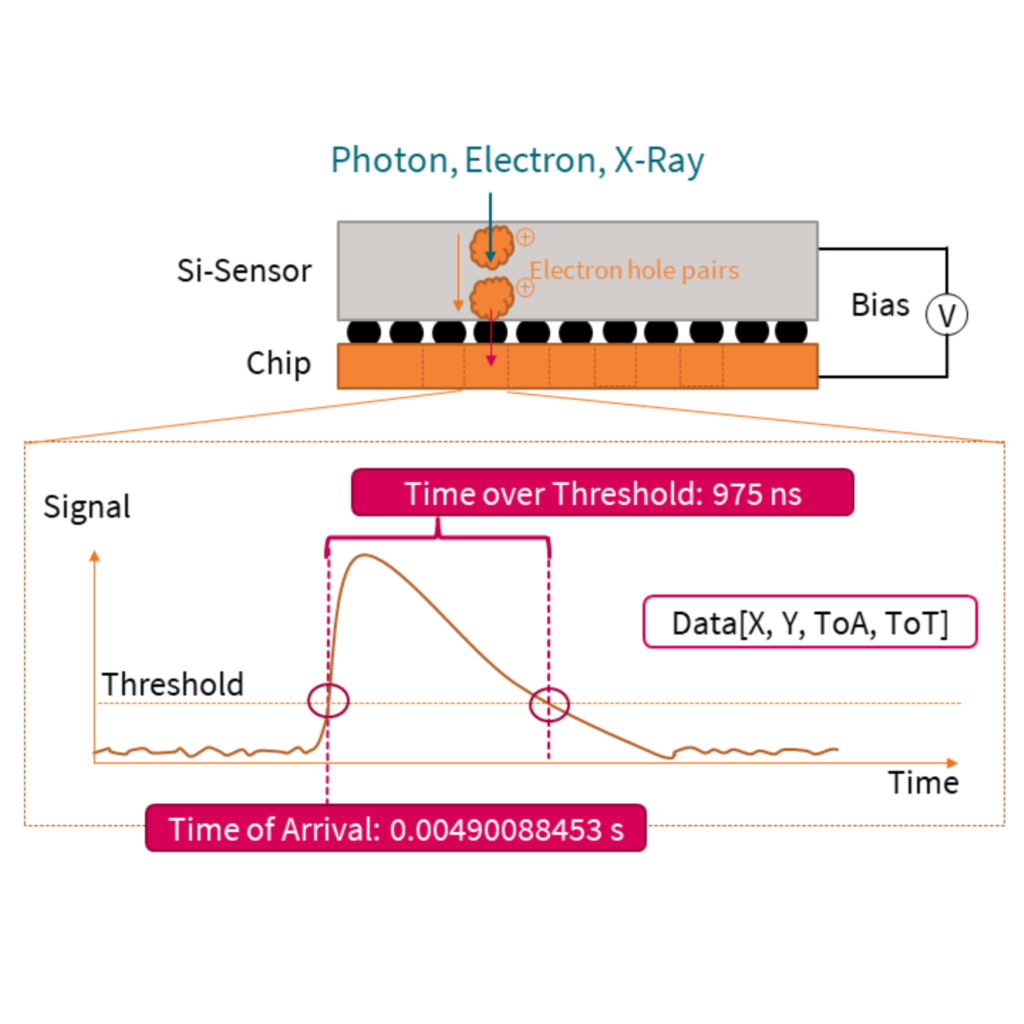
Because data is produced only when a particle is detected, datasets stay small and meaningful. The result is single-particle sensitivity, noise-free imaging, nanosecond timing, and the ability to follow fast, dynamic, or beam-sensitive processes that frame-based detectors miss.
Timepix3 and Timepix4 are event-driven (data-driven) chips: they report each hit the instant it crosses threshold, each with its own timestamp. There are no frames, so the data stream contains only real events. This suits sparse, time-resolved, or asynchronous signals, and means data volume scales with the number of real hits rather than a fixed frame rate.
Powers CheeTah, FeliS, Hyperion, Phoebe, Chronos, Telesto, and LynX T3.
Powers LynX T4, the Timepix4-based Hyperion, and FeliS T4.
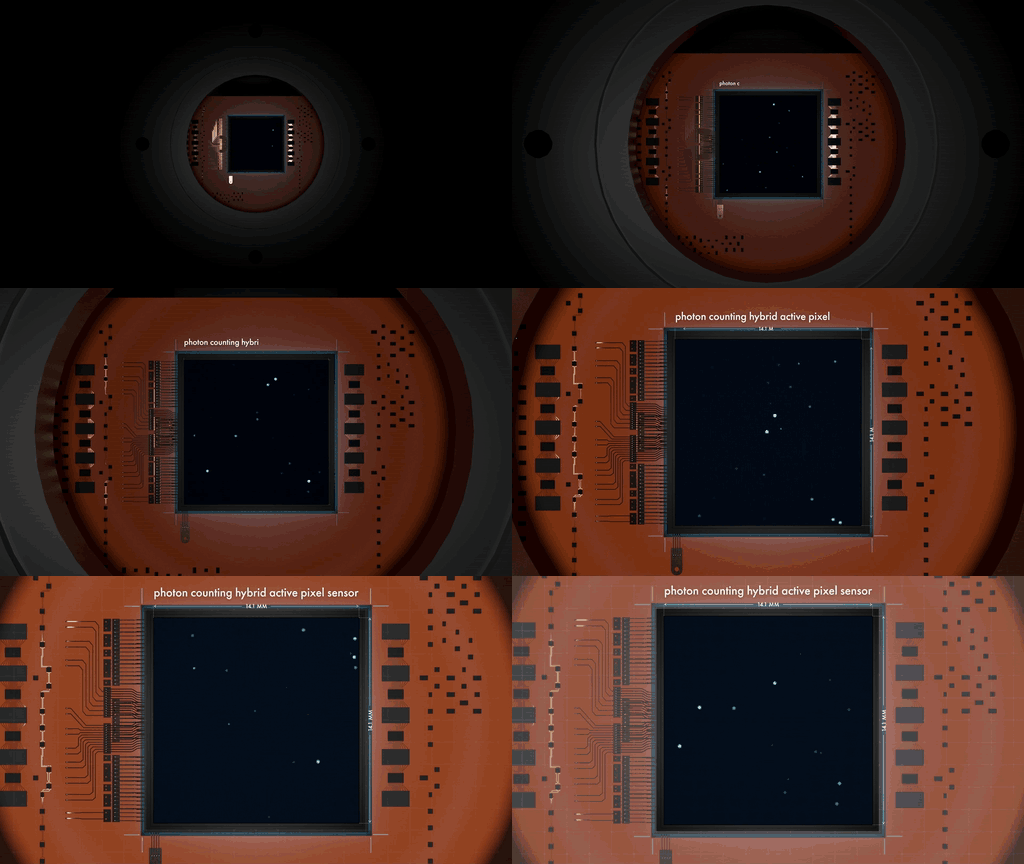
Every ASI pixel is a digital pixel: it counts and time-stamps hits with its own on-chip electronics, so data leaves the detector already digitised. To place those events in the context of a wider experiment, the detectors use Time-to-Digital Converters (TDCs).
For the most demanding timing, ASI integrates the PicoTDC — a Time-to-Digital Converter developed at CERN — directly inside the detector. It timestamps external triggers with sub-10 ps precision and injects them straight into the Timepix data stream, alongside each hit's position and arrival time, so there is no separate timing instrument, no stitching of data formats, and no synchronisation overhead.
Where it makes the difference:
Medipix3, also developed at CERN, takes the complementary approach to Timepix. Instead of time-stamping individual hits, each pixel counts photons above one or more energy thresholds during an exposure and reads out complete frames. It suits steady, high-flux imaging where energy thresholding matters, and shares the same 55 µm, 256 x 256 geometry as Timepix3.
Used in LynX M3, CheeTah M3, FeliS M3.
Frame-based and event-driven detection answer different experimental needs.
| Chip | Readout | Best for |
|---|---|---|
| Medipix3 | Frame-based photon counting with energy thresholds | High-flux, steady-state imaging where energy discrimination matters. |
| Timepix3 | Event-driven, 1.56 ns timestamps | Time-resolved, single-particle work; the most mature, widely configured ecosystem. |
| Timepix4 | Event-driven or frame-based, about 195 ps timestamps | The finest timing (below 200 ps), the largest gap-free area, and the highest hit rates. |
Every ASI detector runs through one connected software ecosystem, built around an open HTTP API so a detector drops straight into an existing beamline, microscope, or instrument-control setup. Three tools cover the whole workflow: Serval controls the hardware and streams the data, Accos provides a full graphical cockpit, and Luna turns the raw event stream into analysis-ready datasets.
Serval is ASI's control and data-acquisition server: a single HTTP API that drives every detector in the portfolio, so any language or tool that can speak HTTP can run an acquisition with no proprietary client software. It is built for high-throughput streaming, exposing configurable output channels for raw events, processed images, and live previews that can all run at the same time to disk, TCP, or HTTP.
Accos is the graphical interface for the whole ASI detector portfolio, designed to make advanced hybrid pixel detectors approachable without hiding their depth. Real-time image preview with live intensity and Time-of-Flight histograms gives immediate feedback during acquisition, while guided per-pixel equalisation and threshold optimisation keep each detector performing at its best. Because it talks to the hardware through the Serval API, Accos fits straight into larger experimental workflows, and a dedicated 4D-STEM mode adds synchronised scanning for electron microscopy.
ASI detectors are built to keep performing where experiments are hardest.
A detector only helps if it fits your instrument. ASI's mechanical expertise means our detectors can be adapted to almost any experimental setup — custom flanges and vacuum-compatible mounts, instrument-specific geometries, and integration with existing beamlines, microscopes, and chambers.
If you have an unusual geometry or a tricky integration, tell us about your setup — chances are we can make it fit. Get in touch with our team.
.svg.webp)

