
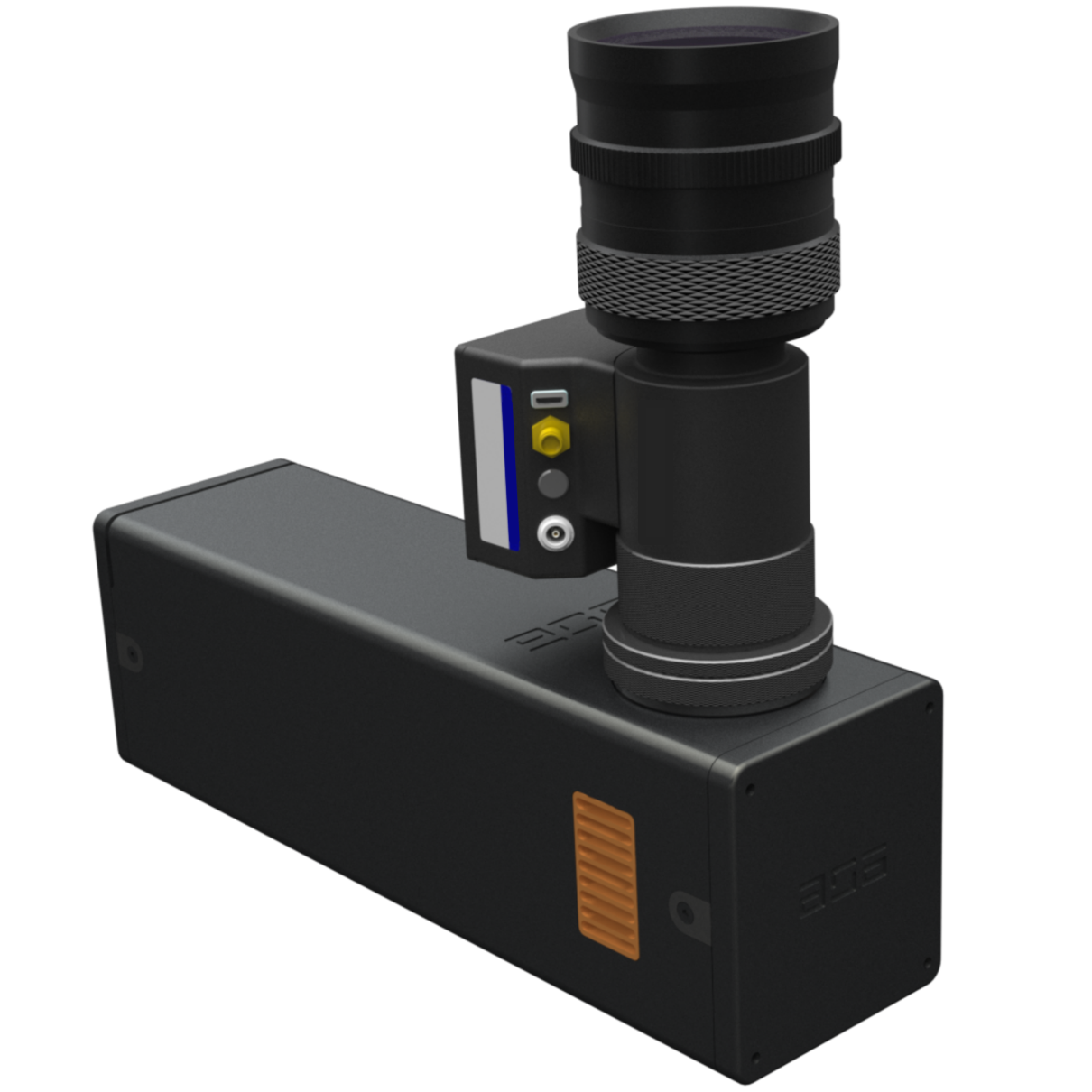
A Timepix3- or Timepix4-based single-photon camera for time-resolved imaging and photon-correlation experiments. In event-driven mode it time-stamps individual photons with sub-nanosecond precision when coupled to an optical intensifier.
The Detectors Behind your discovery!
Phoebe operates in event-driven mode without external triggering, which suits sparse, asynchronous photon events at low dead time. It is typically coupled to optical sensors with high quantum efficiency across the 400 to 950 nm range. Each pixel measures Time-of-Arrival for hits above a set threshold and stores Time-over-Threshold information related to deposited energy.
The combination of nanosecond temporal resolution, spatial imaging, and noise-free single-photon detection through intensifier coupling makes Phoebe suitable for quantum optics, entanglement studies, and time-resolved spectroscopy, where both spatial and temporal information about individual photons are required.
Key features

Single-photon imaging, detection, and correlation.
SPDC, Hong-Ou-Mandel, g(2), and multi-photon correlation studies.
Qubit-specific state detection and quantum simulation on ion lattices.
Continuous, granular processes such as spontaneous emission.
Imaging of weak, sparse light fields with low dead time.
Fluorescence-lifetime imaging using per-photon timing.
.svg.webp)